Recycling and Sustainability at Upminster Skip Hire
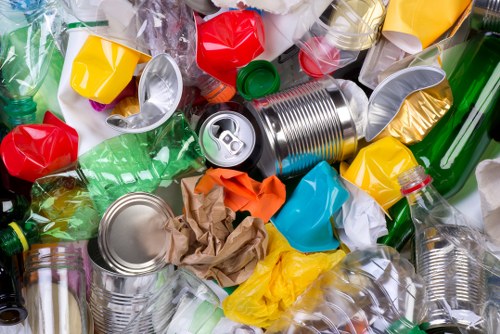 At Upminster Skip Hire we prioritise an eco-friendly waste disposal area and a long-term sustainable rubbish area for the whole community. Our approach to skip hire Upminster balances practical site-management with ambitious environmental goals. We work to ensure that every skip load is managed to reduce landfill, increase material recovery, and support local reuse. Our commitment is to be more than a service: we want skip services in Upminster to be a vehicle for measurable environmental improvement.
We coordinate closely with the borough's approach to waste separation, aligning our sorting processes with local council guidance so that paper, glass, plastic, metal and organic waste streams are separated where possible. Following the boroughs' evolving recycling rules, including separate collections for garden and food waste where available, helps our crews maximise diversion from landfill and comply with local transfer station requirements.
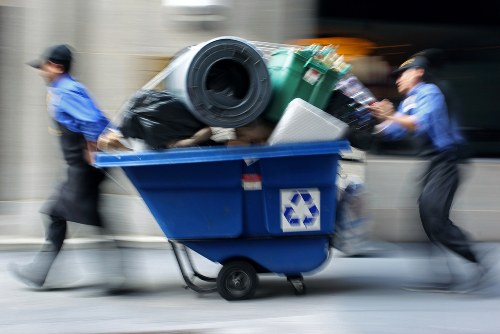 Our sustainability plan sets a clear recycling percentage target: we aim to recycle at least 70% of all skip contents by 2028, with an interim target of 60% by the end of 2026. This target applies across domestic and commercial skips, and is supported by on-site segregation, improved waste auditing, and investment in downstream reuse channels.
To hit those targets we make use of authorised local transfer stations and borough recycling centres. We partner with transfer stations and Household Waste Recycling Centres (HWRCs) across Havering and neighbouring boroughs, ensuring that materials sorted at source are moved quickly to the correct facilities for processing. Our logistics are designed so that glass, inert hardcore, metals, timber and mixed general waste follow the correct chain of custody to minimise contamination.
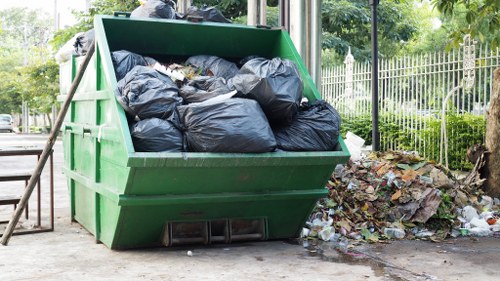 We believe strong local partnerships are essential. That is why skip hire Upminster works with municipal transfer facilities and specialist processors for construction & demolition arisings, garden waste, and separated recyclables. Using local infrastructure reduces haulage distances and carbon emissions, and supports the circular economy by keeping materials in the region for reprocessing.
Our team records waste streams from every skip, producing internal reports that help us refine operations and reduce residual waste. Upminster skips are tracked so we can identify opportunities to increase reuse, for example by diverting good-condition timber and salvageable fixtures to refurbishers rather than sending them to be chipped or burnt.
Partnerships with charities and social enterprises are a core part of our sustainability model. We regularly collaborate with local charities to rescue items that are still usable — furniture, fixtures, and household goods that homeowners or businesses no longer need. Working with organisations such as community reuse centres and regional charity networks helps the materials find a new life and supports people in the borough.
 Our charitable partnerships also include training schemes and small-scale refurbishment initiatives; recovered items are channelled to projects that refurbish and redistribute goods, creating social value from what would otherwise be waste. These collaborations reduce disposal volumes and provide direct community benefit.
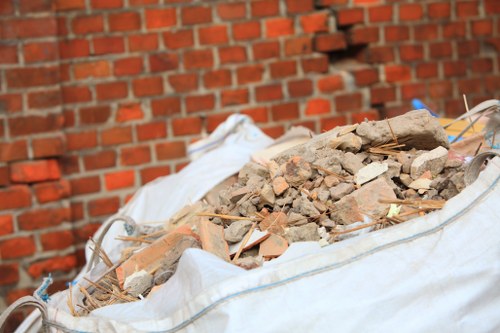
We operate a clear hierarchy of waste handling: reduce, reuse, recycle, recover, and only as a last resort send to landfill. Practical examples of this hierarchy in action include diverting bricks and hardcore to local reclamation yards, sending metal for recycling, composting garden arisings, and transferring clean timber to reprocessors.
Our fleet upgrades form another pillar of our sustainable rubbish area strategy. We are rolling out low-carbon vans and electric vehicles across routes in and around Upminster. The mix of hybrid and battery-electric vans reduces idling, lowers particulate emissions in residential streets, and cuts our overall CO2 footprint per skip moved. Low-emission vehicles also make urban deliveries quieter, supporting better neighbourhood relations during collections.
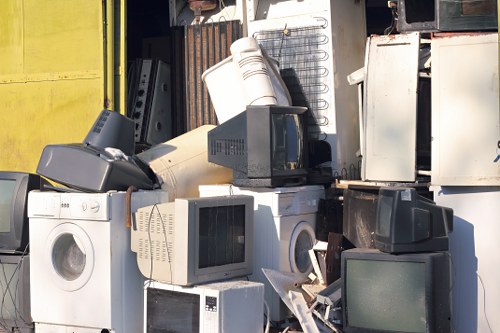 Safety and compliance go hand in hand with sustainability. Our crews are trained in best-practice waste separation, contamination avoidance, and efficient loading to maximise payloads without compromising safety. We enforce clear labels on every skip and offer guidance (on-site) about what can be reused, recycled or must be handled separately, aligning with borough-level separation practices.
What you can expect from our sustainable skip services
- Transparent waste audits so customers understand recycling performance.
- Local transfer station use to keep materials within the regional circular economy.
- Charity partnerships that prioritise reuse of usable items.
- Low-carbon vehicle fleet for reduced emissions and quieter operations.
Our ongoing sustainability commitments
We continually review our processes and will update targets and practices in line with emerging best practice. As part of our long-term promise, Upminster Skip Hire will publish annual performance summaries of recycling rates, reuse volumes and fleet emissions reduction progress. By combining improved sorting, local transfer station use, charity partnerships and a low-carbon fleet, we aim to make sustainable skip hire in Upminster the normal and expected choice for residents and businesses.
Whether you need skips for a garden clearance, renovation project or commercial clearance, choosing us means choosing a partner that seeks to turn your waste into value with measurable environmental benefits. Join us in making the local waste system greener — for the borough, for neighbours, and for future generations.